
In the Philippines, the Department of Environment and Natural Resources (DENR) is the lead agency responsible for the conservation, management, and development of the country’s environment and natural resources, such as forests, watersheds, and public lands. It also oversees licensing and regulation of these resources for their sustainable and equitable use.

In this article, we’ll provide a comprehensive guide on Environmental Compliance Certificate (ECC) in the Philippines, including its covered projects and undertakings, legal bases, documentary requirements, and application process. 

What is an Environmental Compliance Certificate (ECC)?

An Environmental Compliance Certificate (ECC) is an official decision document issued by the Department of Environment and Natural Resources (DENR) in the Philippines through its Environmental Management Bureau (EMB) to certify that a proposed project or undertaking has complied with the Environmental Impact Statement (EIS) System requirements, and that the proponent is committed to implementing its approved Environmental Management Plan (EMP) to manage environmental impacts. 

  • An Environmental Compliance Certificate (ECC) is required for projects and undertakings that may affect the environment (e.g., construction, mining, manufacturing, etc.).
  • It is issued after an Environmental Impact Assessment (EIA) conducted by the DENR-EMB.
  • It confirms that the project or undertaking has complied with the Philippine Environmental Impact Statement (EIS) System under P.D. 1586. 
  • It specifies conditions and environmental safeguards the project proponent must follow during implementation, operation, and even abandonment of the project or undertaking.
  • It is not a permit to operate but a prerequisite to securing other additional permits and licenses

Legal Bases of DENR-EMB Environmental Compliance Certificate (ECC)

The issuance of an Environmental Compliance Certificate (ECC) is grounded in the 1987 Constitution of the Philippines, key environmental laws, and proclamations that mandate environmental assessment for certain projects and undertakings. 

1987 Constitution of the Philippines

Section 16 of the 1987 Constitution of the Philippines establishes the right and duty to live in harmony with nature, providing that “the State shall protect the right of the people to a balanced and healthful ecology in accord with the rhythm and harmony of nature.”

Philippine Environmental Impact Statement System (P.D. 1586)

Section 4 of P.D. 1586, which establishes the Philippine Environmental Impact Statement (EIS) System, mandates that “no person, partnership, or corporation shall undertake or operate any such declared environmentally critical project or area without first securing an Environmental Compliance Certificate (ECC).

Presidential Proclamation Nos. 2146 and 803

These proclamations have defined environmentally critical projects (ECPs) and environmentally critical areas (ECAs) within the scope of the Environmental Impact Statement (EIS) System established under Presidential Decree No. 1586.  

Toxic Substances and Hazardous and Nuclear Wastes Control Act of 1990 (R.A. 6969)

This law protects public health and the environment from the harmful effects of toxic and nuclear materials by regulating the importation, manufacture, use, and disposal of chemical substances and hazardous wastes in the Philippines.  

Philippine Clean Air Act of 1999 (R.A. 8749)

This law promotes clean air in the Philippines by providing a comprehensive policy for air pollution prevention and by regulating emissions from industrial, mobile, and stationary sources without compromising economic development. 

Ecological Solid Waste Management Act (R.A. 9003)

This law mandates the proper segregation, collection, and disposal of solid waste through an ecological and sustainable approach. It requires local government units to implement solid waste management plans and establish materials recovery facilities (MRFs).

Philippine Clean Water Act of 2004 (R.A. 9275)

This law aims to protect the country’s water bodies from pollution by regulating the discharge of wastewater and requiring treatment before release. It promotes sustainable water use and requires industries and local governments to manage water quality through monitoring and compliance programs. 

What Projects Require an Environmental Compliance Certificate (ECC) in the Philippines? 

Any individual, company, or organization planning to undertake a project that may substantially affect the environment, such as large-scale construction, mining, industrial operations, and land development, must apply for an Environmental Compliance Certificate (ECC) before starting the project.  

The Environmental Impact Statement (EIS) System serves as a regulatory framework in the Philippines established under Presidential Decree No. 1586 to ensure that environmentally critical projects or projects located in environmentally sensitive areas undergo proper environmental assessment before implementation. Under the EIS System, projects and undertakings that can impact the environment are categorized as follows:

Category A – Environmentally Critical Projects (ECPs)

Requiring a DENR-EMB Environmental Compliance Certificate (ECC), these projects or undertakings are classified as environmentally critical projects (ECPs) under Presidential Proclamation No. 2146 (1981) and Proclamation No. 803 (1996). Under this category are four subcategories, which include:

  • heavy industries (e.g., non-ferrous metal industries, iron and steel mills, and smelting plants), 
  • resource extractive industries (e.g., mining, quarrying, and forestry projects),
  • infrastructure projects (e.g., dams, power plants, reclamation projects, roads, and bridges), and 
  • golf course and other tourism projects   

Category B – Environmentally Critical Area (ECA) Projects

Also requiring a DENR-EMB ECC, these projects or undertakings, which are not classified as ECP under Category A but which are likewise deemed to significantly affect the quality of the environment by virtue of being located in Environmentally Critical Areas (ECAs) as declared under Proclamation 2146 and according to the parameters set forth in the succeeding sections. In accordance with the proclamation, there are twelve (12) subcategories of ECAs:

  • areas declared by law as national parks, watershed reserves, wildlife preserves, and sanctuaries; 
  • areas set aside as aesthetic, potential tourist spots;
  • areas that constitute the habitat for any endangered or threatened species of indigenous Philippine wildlife (flora and fauna); 
  • areas of unique historic, archeological, geological, or scientific interests; 
  • areas that are traditionally occupied by cultural communities or tribes; 
  • areas frequently visited and or hard-hit by natural calamities; 
  • areas with critical slope; 
  • areas classified as prime agricultural lands; 
  • recharge areas of aquifers;
  • water bodies; 
  • mangrove areas; and 
  • coral reefs

Category C – Environmental Enhancement or Direct Mitigation Projects

These projects or undertakings do not fall under Category A, Category B, and which are intended to directly enhance the quality of the environment or directly address existing environmental problems. 

Category D – Other Projects Not Covered by EIS System

These projects or undertakings are deemed unlikely to cause significant adverse impact on the quality of the environment according to the parameters set forth in the screening guidelines. They are not covered by the Philippine EIS system and are not required to secure an ECC. However, such non-coverage shall not be construed as an exemption from compliance with other environmental laws and government permitting requirements.

Certificate of Non-Coverage (CNC)

Projects and undertakings under Category C and Category D, and those which are not covered by the EIS System and do not require securing an ECC may still require a DENR Certificate of Non-Coverage (CNC). These may include small-scale agricultural projects, low-impact commercial establishments, and minor infrastructure projects.  

Environmental Compliance Certificate (ECC) Requirements

The application requirements for an Environmental Compliance Certificate (ECC) are based on the guidelines set by the DENR and EMB to ensure proper evaluation of the environmental impact of a project or undertaking. Generally, these include:  

  1. Project Description
  2. Environmental Impact and Management Plan (EIMP)
  3. Abandonment, Decommissioning, and Rehabilitation Information
  4. Geotagged Photographs of project site (taken for last 30 days)
  5. Topographic Map of impact or affected areas (at least 1km from the project boundaries)
  6. Certification from LGU on the compatibility of proposed project with existing land use plan
  7. Site Development and/or Vicinity Map signed by registered professionals
  8. Project or Plant Layout signed by registered professionals
  9. Schematic Diagram of wastewater treatment facility
  10. Schematic Diagram of air pollution control facility
  11. Organizational Chart in charge of environmental concerns
  12. Proof of Authority over the project site (land title, lease contract, deed of absolute sale, etc.)
  13. Duly Notarized Accountability Statement of proponent
  14. Duly Accomplished Project Environmental Monitoring and Audit Prioritization Scheme (PEMAPS) Questionnaire
  15. Initial Environmental Examination (IEE) Checklist Sworn Statement
  16. Bank Receipt (Application Fee)
  17. Affidavit of No Complaint
  18. Project Components and Operation Information

Comprehensive, Efficient, and Compliant

Need Help with Your Compliance Reports and Filings?

Let us handle your compliance needs with government agencies, so you can focus on growing your business without the worry of penalties or interruptions.

How to Apply for an Environmental Compliance Certificate (ECC) in the Philippines

To secure a DENR-EMB Environmental Compliance Certificate (ECC), your project or undertaking must first undergo an Environmental Impact Assessment (EIA) or Initial Environmental Examination (IEE) and comply with all environmental standards. Here’s a step-by-step guide to the ECC application process: 

1. Facilitate the Environmental Impact Assessment (EIA).

You must first facilitate the Environmental Impact Assessment (EIA), which generally involves evaluating and predicting the environmental impacts (including cumulative impacts) during construction, commissioning, operation, and abandonment. This involves you as the project proponent (or your EIA Consultant), DENR-EMB, a Review Committee, affected communities, and other stakeholders. 

2. Prepare Documentary Requirements for ECC Application.

Due to the extensive documentary requirements, gathering all necessary documents may take some time. To avoid delays or unnecessary expenses, it’s essential to coordinate directly with the DENR-EMB for the most complete and up-to-date list of requirements.

3. Process the Online Registration and Fee Payment.

Visit the ECC Online Application System and download the User’s Guide for a detailed step-by-step online registration and application process. Verify your project or undertaking and fill out the online Initial Environmental Examination (IEE) Checklist form. Once finished, proceed to any Land Bank branch and pay the processing fee. Finally, upload all the documentary requirements as instructed in the guide.   

4. Wait for the Review and Approval by the DENR-EMB.

The DENR-EMB will then evaluate your ECC application based on the uploaded documents and the Environmental Impact Assessment (EIA). Such evaluation may result in either approval or a request for additional information or documents.  

5. Receive the Environmental Compliance Certificate (ECC).

If your application meets all requirements and passes the review, the DENR-EMB will issue the Environmental Compliance Certificate (ECC). You may then proceed with your project or undertaking, as long as you comply with all the conditions stated in the certificate.  

6. Ensure Ongoing Compliance.

After receiving the ECC, you must maintain continuous compliance with environmental regulations and the commitments outlined in your EIA. This includes establishing an Environmental Unit within the prescribed period, submitting semi-annual Compliance Monitoring Reports (CMRs), and adhering to the Environmental Management Plan (EMP) and other applicable environmental laws.
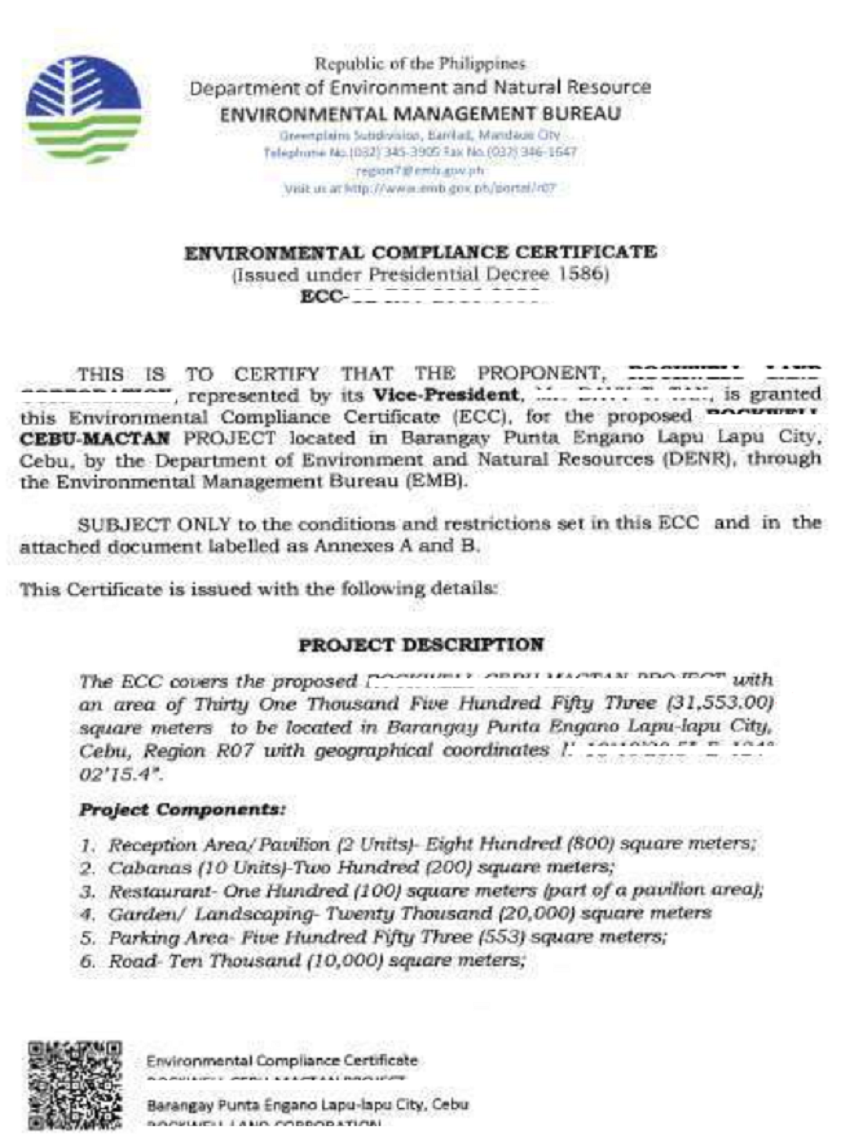
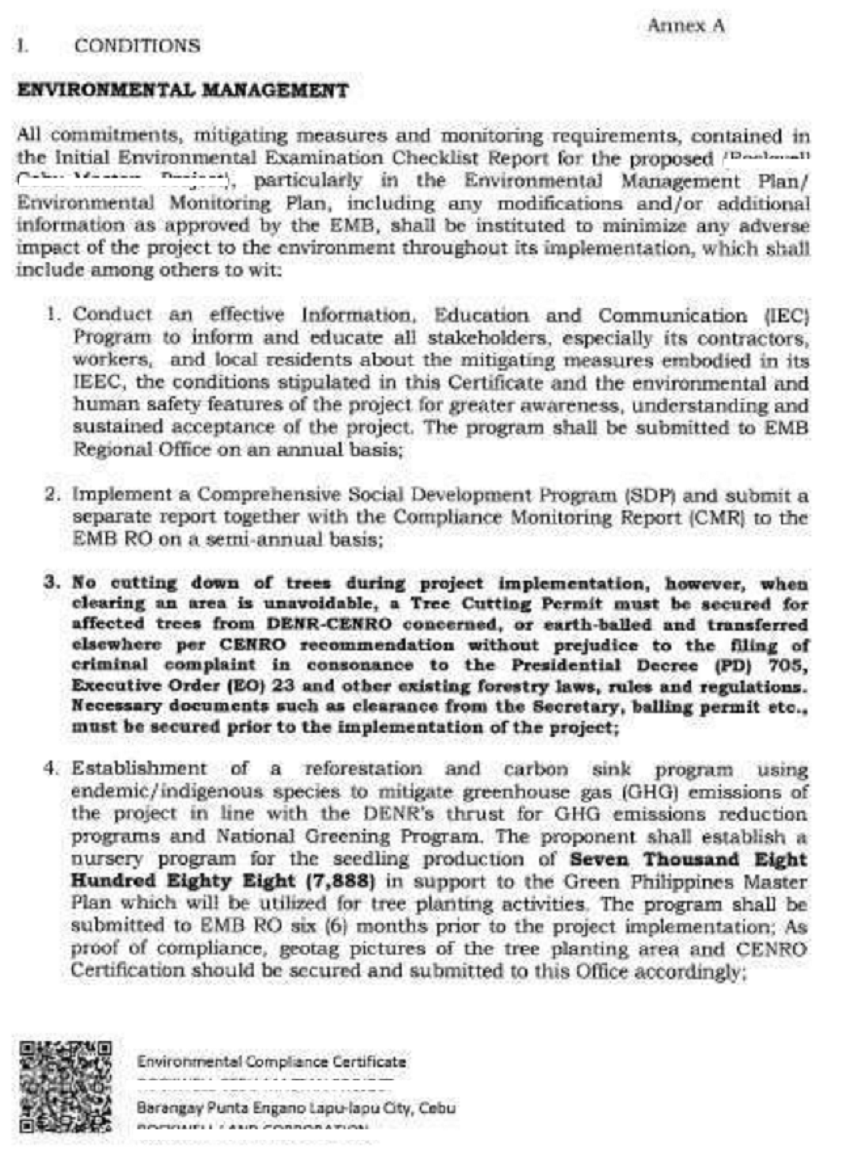
Sample Environmental Compliance Certificate (ECC) in the Philippines

Sample Environmental Compliance Certificate (ECC) in the Philippines

Sample Environmental Compliance Certificate (ECC)

An Environmental Compliance Certificate (ECC) contains specific measures and conditions that the project proponent must undertake before and during the operation of a project, and in some cases, during the abandonment phase, to mitigate identified environmental impacts. These are the salient features of the ECC:

  • Scope of project or undertaking,
  • Conditions as conformed by the proponent to implement mitigation measures for potentially negative impacts and/or enhancement measures for potentially positive impacts as identified in the EIA report,
  • Suggestions or recommendations to assist LGUs and other government agencies to incorporate the EIA results in their decision-making process.  

Environmental Compliance Certificate (ECC) FAQs

Below are some frequently asked questions about the Environmental Compliance Certificate (ECC), intended to clarify common concerns and summarize the key points discussed above:

1. What is the difference between an ECC and a CNC? An Environmental Compliance Certificate (ECC) is required for projects and undertakings that may pose significant environmental risks. On the other hand, a Certificate of Non-Coverage (CNC) is for those that are not covered by the Environmental Impact Assessment (EIA). 

2. Where can I apply for an ECC? You can apply through the DENR-EMB ECC Online Application System or visit the nearest EMB Regional Office for assistance. 

3. How much is the processing fee for ECC and CNC? The processing fees for ECC and CNC are PHP 5,070 and PHP 1,040, respectively.  

4. How long does it take to get an ECC? The processing timeline for an ECC depends on the project’s complexity, completeness of requirements, and other factors. On average, it can take anywhere from 20 to 120 working days. Processing of a CNC, on the other hand, can take only seven (7) working days.  

5. Can I start the project while waiting for the release of the ECC? No. You must first obtain an ECC before any site development, construction, or operation begins. Starting without the certificate can result in penalties, suspension, or project closure. 

6. When should an existing project apply for an amendment to its ECC? An existing project must apply for an ECC amendment with the DENR-EMB Regional Office if it undergoes expansion, rehabilitation, or modification. Major amendments include increases in project area, capacity, or changes in technology or process flow.

7. What qualifies as a minor amendment to an ECC? Minor amendments include changes such as in the company name or ownership, reduction in land or production capacity, correction of typographical errors, or adjustments in project layout that do not affect the process or output.

8. What is the validity of an ECC? Generally, an ECC has a validity of five (5) years from the date of issuance. 

9. Can an ECC be revoked or canceled? Yes. The DENR-EMB may revoke the issued ECC if the project proponent violates the conditions, fails to submit required reports, or causes unforeseen environmental damage. 

10. What happens if the project has not been implemented within five (5) years? If the proponent fails to implement the project within five years from the issuance of an ECC, the certificate loses its validity, and a request for extension must be filed before its expiration. The period of extension depends on all submitted documents but in no case exceeds a period of another five (5) years. 

… and you might just need our assistance.

At FilePino, we ensure our team stays updated with the latest rules and regulations governing business compliance across various government agencies. We also leverage our extensive experience and expertise in navigating the intricacies of transactions. 

Need help with obtaining a DENR-EMB Compliance Certificate (ECC)? Set up a consultation with FilePino today! Call us at (02) 8478-5826 (landline) and 0917 892 2337 (mobile) or send an email to info@filepino.com.