




In the Philippines, the export industry is a dynamic engine of economic growth, fueled by top-performing sectors like electronics, semiconductors, and agricultural products. The country leverages its strategic location in Southeast Asia, competitive labor force, and strong trade alliances to connect seamlessly with global markets and strengthen its reputation as a reliable export hub. 

Foreign Investments Act (FIA) of 1991

The Foreign Investments Act of 1991 (R.A. 7042) has liberalized the Philippine economy by allowing 100% foreign ownership in most businesses, except those listed in the Foreign Investment Negative List (FINL). It has attracted foreign investments that significantly contribute to national industrialization, socioeconomic development, and the expansion of livelihood and employment opportunities for Filipinos.

While the law imposes no limits on foreign ownership of export enterprises, it clearly mandates that these businesses export at least 60% of their total manufacturing output or domestic trade purchases. To ensure compliance, foreign export enterprises must submit annual reportorial requirements to the Board of Investments (BOI).

Board of Investments (BOI)

An agency attached to the Department of Trade and Industry (DTI), the Board of Investments (BOI) promotes investment in the Philippines under Executive Order 226, or the Omnibus Investments Code of 1987. It supports enterprises listed in the Investment Priorities Plan (IPP) and serves as a one-stop shop for both local and foreign investors, helping them explore and succeed in key economic sectors.

What is an Annual Export Performance Report (AEPR)?

An Annual Export Performance Report (AEPR) is a yearly reportorial requirement filed by registered export enterprises with the Board of Investments (BOI), serving as proof of their ongoing compliance with the mandate to export at least sixty percent (60%) of their total output. 

Who Requires AEPRs?

All foreign export enterprises registered with the BOI are mandated to file the AEPR. As defined in the FIA, an “export enterprise” is an enterprise wherein a manufacturer, processor, or service (including tourism) enterprise exports sixty percent (60%) or more of its output, or wherein a trader purchases products domestically and exports sixty percent (60%) of such purchases.

When Must Export Enterprises File Their AEPRs?

The filing period for AEPRs depends on the export enterprise’s accounting period (i.e., either fiscal year or calendar year). If the company follows a calendar year (31st December), the deadline is on the 30th day of May of each year; otherwise, it must be filed within four (4) months from the end of the fiscal year. 

AEPR Form and Other Supporting Documents

Before filing the AEPR with the Board of Investments (BOI), prepare the following documentary requirements:

  1. Duly accomplished Annual Export Performance Report (AEPR) of Foreign Export Enterprises Form
  2. Audited Financial Statements (AFS) with BIR stamp
  3. Income Tax Return (ITR) with BIR stamp
  4. Summary of Monthly Sales for the year, delineating export and domestic revenue
  5. Other additional documents if filed by an authorized representative (board resolution, secretary’s certificate, and valid IDs).
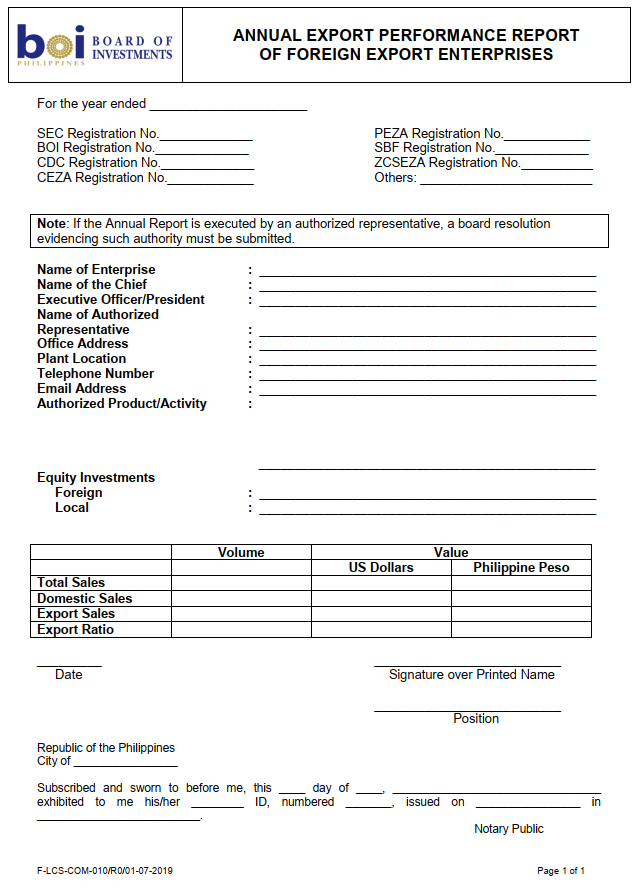

 

Annual Export Performance Report (AEPR) of Foreign Export Enterprises Form

Precise, Reliable, and Compliant

Need Help with Your AEPR Filing?

Just fill out the order form, settle the fees— and our specialists will promptly reach out to begin the swift filing of your Annual Export Performance Report of Foreign Enterprise (AEPR). 

How to File the Annual Export Performance Report (AEPR)

Filing the Annual Export Performance Report (AEPR) is a straightforward process, but it still requires experience and documentation expertise, as penalties apply for late submissions and fraudulent reports. 

1. Prepare the Documentary Requirements.

Fill out the Annual Export Performance Report (AEPR) for Foreign Export Enterprises Form properly and accurately. You need to indicate the applicable taxable year, all special registration numbers, company details, sales and ratios, and other information. Attach all supporting documents as indicated.

2. File the AEPR with the BOI via Email.

Draft a formal transmittal email, attach the form and other documentary requirements, and send it to the designated emails of the Board of Investments (BOI). You may coordinate with the agency for these email addresses.  

3. Submit the Same Documents (in Hard Copies) with the BOI Office. 

After filing via email, submit the same documents (in hard copies) to the BOI Office at the Industry and Investments Building, 385 Senator Gil Puyat Avenue, Makati City, 1200.

4. Receive the Acknowledgement of the Report.

Wait for the BOI Officer to send an acknowledgement receipt via email. A receiving copy of the AEPR with a “received” stamp will also be returned upon submission of the hard copies.  

AEPR Filing Violations and Penalties

Section 1 of Rule XVII (Administrative Sanctions) of the Implementing Rules and Regulations (IRR) of R.A. 7042 provides that non-compliance by any duly registered export enterprise with Rule VI, Sections 3 and 4, shall be subject to the following sanctions:

Late Submission of the AEPR

Violation

Penalty

First Violation

Written Warning

Second Violation

Basic Fine of PHP 1,000 + Daily Fine of PHP 50

Third Violation

Basic Fine of PHP 2,000 + Daily Fine of PHP 100

Subsequent Violations

Basic Fine of PHP 5,000

Submission of Fraudulent Reports

Violation

Penalty

Partnership/Corporation

Sole Proprietorship

First Violation

PHP 100,000

PHP 50,000

Second Violation

PHP 150,000

PHP 70,000

Third Violation

Fine in an amount not

exceeding 1⁄2 of 1% of the

total paid-in capital but not

more than PHP5 Million

PHP 100,000

Subsequent Violations

Cancellation of registration granted under the Act

For non-submission of the required reports within twelve (12) months after the taxable year, the certificate of registration granted under the Act shall be subject to cancellation.

For failure of any duly registered export enterprise to comply, without justifiable reason, with the Securities and Exchange Commission (SEC) or Bureau of Trade Regulation and Consumer Protection (BTRCP) order to increase its export to at least sixty percent (60%) of total sales, the penalties are the same as for the submission of fraudulent reports (See table above).

… and you might just need our assistance.

At FilePino, we ensure our team stays updated with the latest rules and regulations governing business compliance across various government agencies. We also leverage our extensive experience and expertise in navigating the intricacies of transactions. 

Need help with your Annual Export Performance Report (AEPR) filing with the Board of Investments (BOI)? Set up a consultation with FilePino today! Call us at (02) 8478-5826 (landline) and 0917 892 2337 (mobile) or send an email to info@filepino.com.